Crew – the antidote to large teams
In the previous post, we looked at the shadow cost of team size. Larger teams are a high cost to the company. They move more slowly, they reduce employee motivation and well-being, and they are less likely to be high-performing.
Adding one person to the core team doesn’t just add their hours to the project time taken. It adds them plus their management chain, plus advisors they get input from, plus conversations to keep in sync with every other person already on the team. For every 1 core team hour spent doing the work, the team generates an additional 1 hr of shadow cost. A core team of 7 members, each occasionally bringing in advisor input, generates 2.9 x the shadow cost of a core team of 3 who are only bringing in 3 advisors.
To get work done faster, we need fewer Teams and more Crews
A condition of teams is that they are permanent with stable membership. That doesn’t always reflect the reality of what we need to deliver project work in companies today. Sometimes, what the work needs is a CREW:
Compact – Deliberatively small to challenge team bloat. A minimum of 2 and a maximum of 4 core members, each with a specific role.
Rapid – Purposely stood up to get the defined job done in weeks not months. They disperse when the outcome is delivered.
Empowered – They have been given authority to make decisions within the team.
Woven – They include colleagues with a true enterprise mindset who ensure project decisions are consistent with the strategic agenda
There are 5 types of Crew Roles, 3 inside the core team and 2 that deliberately sit outside of the core team:
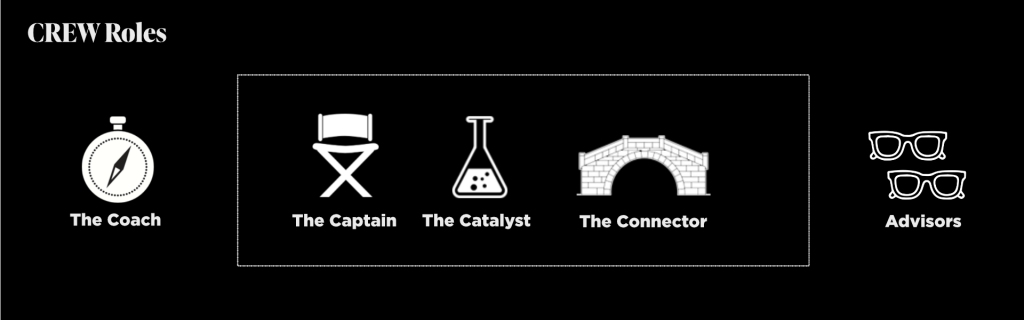
The Captain brings depth.
The Captain holds deep domain knowledge and makes the decision call. They aren’t the most senior person available, but they have a deep understanding of the problem space and the authority to commit resources and make decisions without having to return to a function for permission. The Captain must be able to act, not just report back.
The Catalyst creates constructive friction through adjacent expertise.
The Catalyst has expertise related to, but not identical to, the Captain’s. Their project role is to accelerate the Crew’s thinking by bringing different perspectives, different organisational experience, or a different problem-solving style. The Catalyst speeds up the crew’s thinking and, like the Captain, is developing through the work, building toward captaining their own Crew.
Skilton & Dooley’s (1) finding is that the most creative pairings are people with some shared history but not too much. Teams where everyone has worked together before produce fewer novel solutions. The Captain and Catalyst share enough domain language to communicate efficiently, but enough differences in training and experience to prevent anchoring on a first solution.
The Connector ensures integration.
The Connector is someone from a different discipline within the organisation who brings outsider value and cross-boundary networks. They are outsiders whose value lies not in knowing the domain but in having access to diverse knowledge networks, toolkits, and relationships. They ask the naive questions that spark reconsideration. As an integrator, they are organisationally savvy. They bring an enterprise mindset and strong intuition about how project outcomes support the broad agenda. They are delivering the Woven attribute of CREW.
2 roles outside of the Crew Core team
The Coach
- Helps the Captain see blind spots and choices that the crew can’t see from inside the problem
- Provides strategic context and organisational navigation alongside the Connector.
- Holds the developmental lens, ensures each Crew member is stretched, not just productive
- Asks questions
But doesn’t
- Make decisions for the Crew. That’s the Captain’s job
- Attend Crew working sessions as a standing member
- Own the outcome, the Crew owns it. The Coach supports developmental growth
- Provides answers
Advisors
There are 2 types of Advisor input:
The Functional Advisor. When the Crew hits a question that requires expertise none of them holds, they pull in a specialist. This is the functional contribution that typical cross-functional teams try to achieve with permanent membership but delivered without the coordination drag.
The Stakeholder Advisor. Before the Crew’s output goes live, share it with 2–3 people who will be affected by the decision or need to implement it. It’s intelligence-gathering: what implementation risks do we not see? What political dynamics should we navigate?
How many Catalysts and Advisors?
The intent should be to have the smallest Crew configuration that has the capacity and capability to deliver the work without coordination drag.
The project topic, problem type and project stage should drive the composition
What expertise is needed, and how many colleagues do you need within the Crew to deliver the project with momentum? Workstreams move through scoping, development and implementation, each requiring different team involvement and interaction patterns. An implicit strength of Crews is that they are configured to deliver greater novelty than teams that become less innovative over time (2).
Requisite, not maximum variety
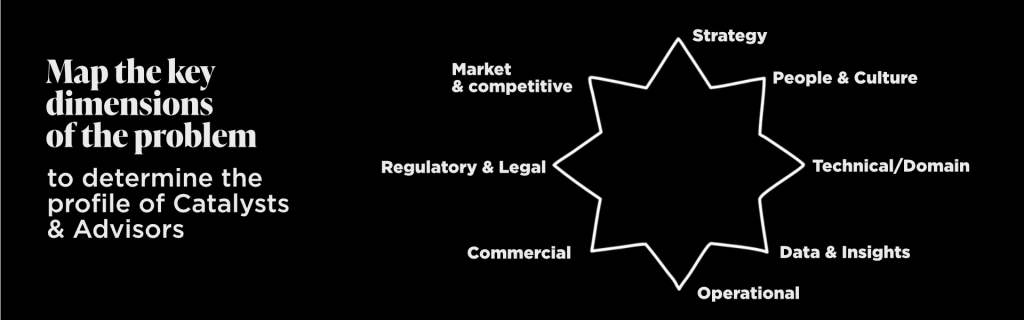
A system needs enough internal variety to match the variety of the problem it’s facing but no more (3). Map the key dimensions of the problem and ensure at least one person covers each dimension. Not every project/problem activates every dimension. Identify which dimensions are genuinely in play, and recruit accordingly. This reframes the question from ‘who might be useful’ to ‘which dimensions are currently uncovered?’
Illustrative Example
A personal lines insurer is losing too many new policyholders before their first renewal. Analysis points to a broken post-sale experience. Customers feel unsupported after purchase, undervalue their cover, and are receptive to competitor quotes at renewal. The solution sits in the communication and service journey, not in pricing.
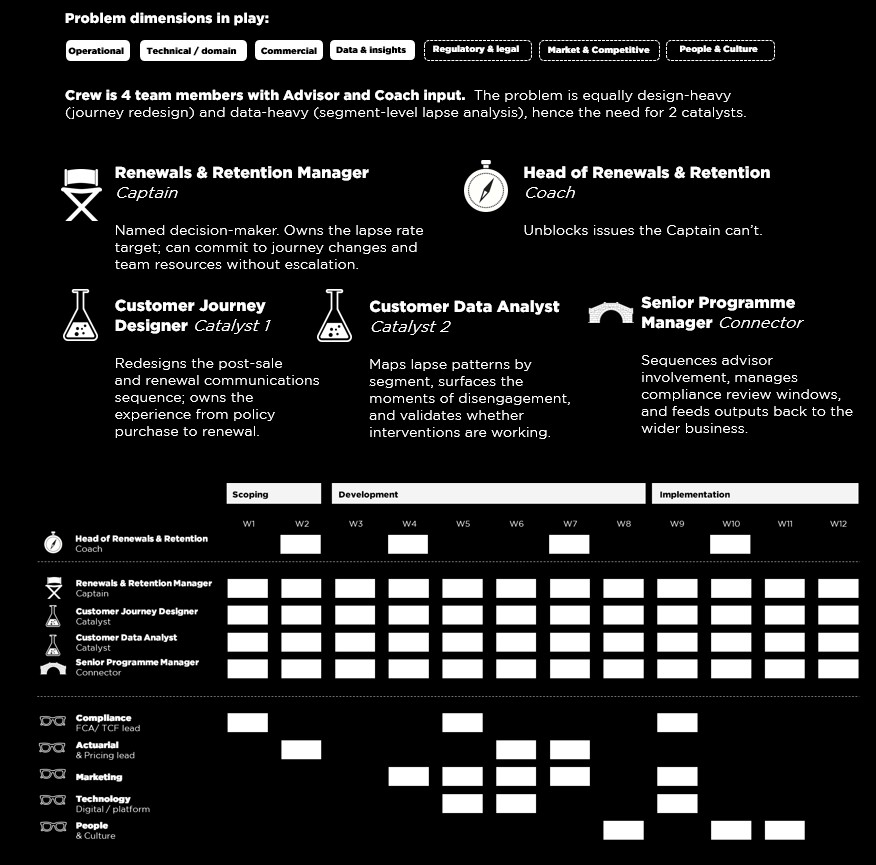
Advisors make select, time-bound contributions at specific moments
Scoping (weeks 1–2)
FCA rules on renewal pricing and Treating Customers Fairly need to be understood by the core team, so Compliance inputs in week 1. Actuarial/Pricing joins in week 2 to brief the team on which levers are available and which are off the table.
Development (weeks 3–8)
Marketing joins from week 4 through 7 to co-design the communications sequence alongside the catalyst Journey Designer. Actuarial returns in
weeks 6–7 to pressure-test any interventions that touch pricing perception or cover communication. Technology comes in weeks 5–6 to assess what’s deliverable within the existing policy admin and CRM platform. Compliance returns in week 5 because FCA obligations require a formal design review before anything customer-facing is finalised.
Implementation & sustainment (weeks 9–12)
Compliance makes a third input at week 9 for the sign-off. Technology and Marketing each have a single touch at launch. People & Culture now enters because if the redesigned journey changes how the contact centre handles inbound renewal calls, that behaviour change starts in week 8 and runs through weeks 10–11.
Final Thoughts
We are collaborating too much. It’s become a growing pressure for over a decade. Company overload (too many initiatives and demands) creates personal overwhelm (employees within the company are overwhelmed by the overloaded system). Adding one person to the core team doesn’t just add their hours to the project time taken. It adds a shadow cost. Larger teams are a high cost to the company. They move more slowly, they reduce employee motivation and well-being, and they are less likely to be high-performing.
We need fewer Teams and more Crews. Teams by definition have stable membership and are enduring. Crews, by contrast, are compact, temporary, empowered and well strongly connected to the enterprise agenda.
You can download a pdf summary of ‘The Shadow Cost of Teams’ at Dropbox
Footnotes
(1) Skilton & Dooley’s (2010)
(2) Ralph Katz (1982) studied R&D teams and found that as teams stayed together longer, their performance on innovative tasks actually declined after about 3-5 years. Teams become increasingly isolated from external information sources. – Gersick & Hackman (1990) found that teams develop habits that initially boost efficiency, but these routines eventually become constraints on creativity.
(3) Ashby’s Law