Your Capacity Reality Check

As things start to ramp up after the holiday period, it’s a good time to think strategically about how you are going to achieve your team goals this year. I’ve previously written about setting team-level goals and ensuring your team’s workload is manageable. Project Prioritisation becomes a moot point, though, if you don’t understand how much capacity you really have in your working week. And the reality may surprise you.
You’re likely spending more time communicating than creating
Research from Microsoft’s Work Trend Index and Asana’s 2023 Anatomy of Work is highly consistent in its findings. The average office worker is spending 60% of their week in coordination tasks, leaving 40% for creative, technically skilled and strategic work [note: in the diagram below, this is referred to as working with documents, because Microsoft analysed the time spent in 365 applications].
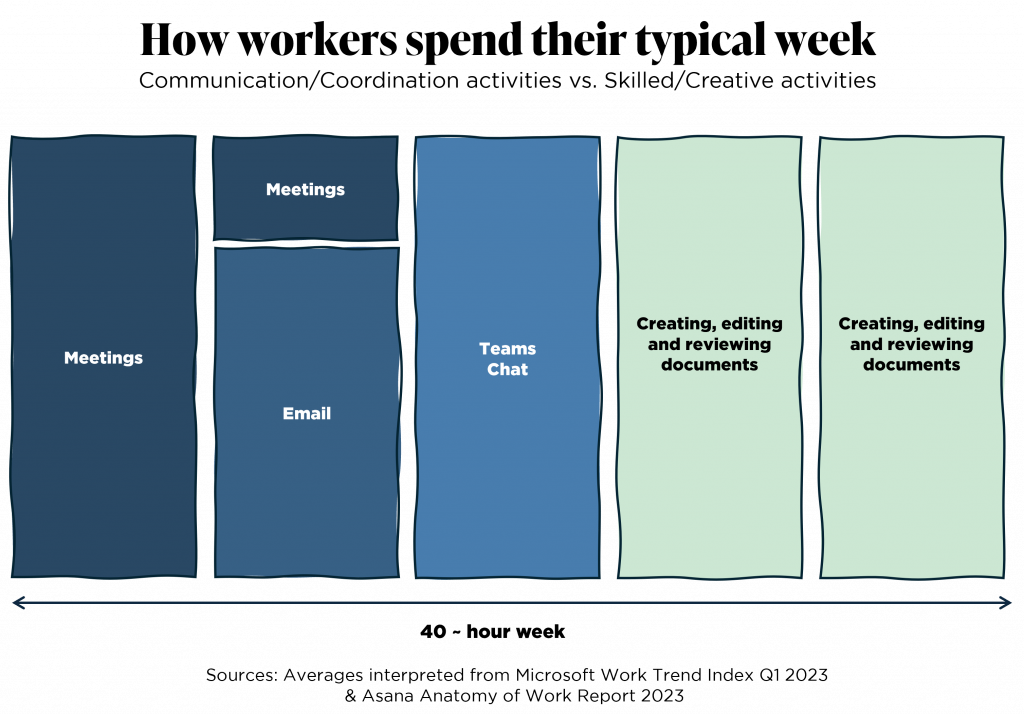
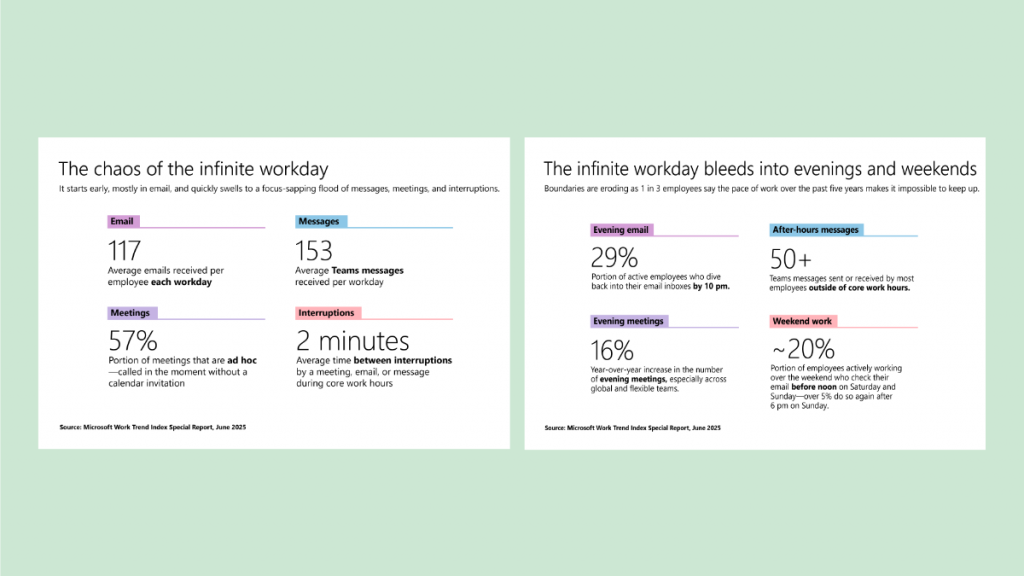
Coordination bloat has become a significant consequence of cross-functional work (1), and Asana’s report has an unfavourable term for this, namely ‘work about work.’ The impact of this barrage of communication is really significant, as 2025 Microsoft data highlights. We’re surviving with a triage mentality. 85% of emails are read in under 15 seconds. Workers read four emails for every one they send.
The Capacity Reality Check
Paul Graham famously wrote about the Manager’s Schedule back in 2009. We recognise the feeling of the Tetris calendar all too well.
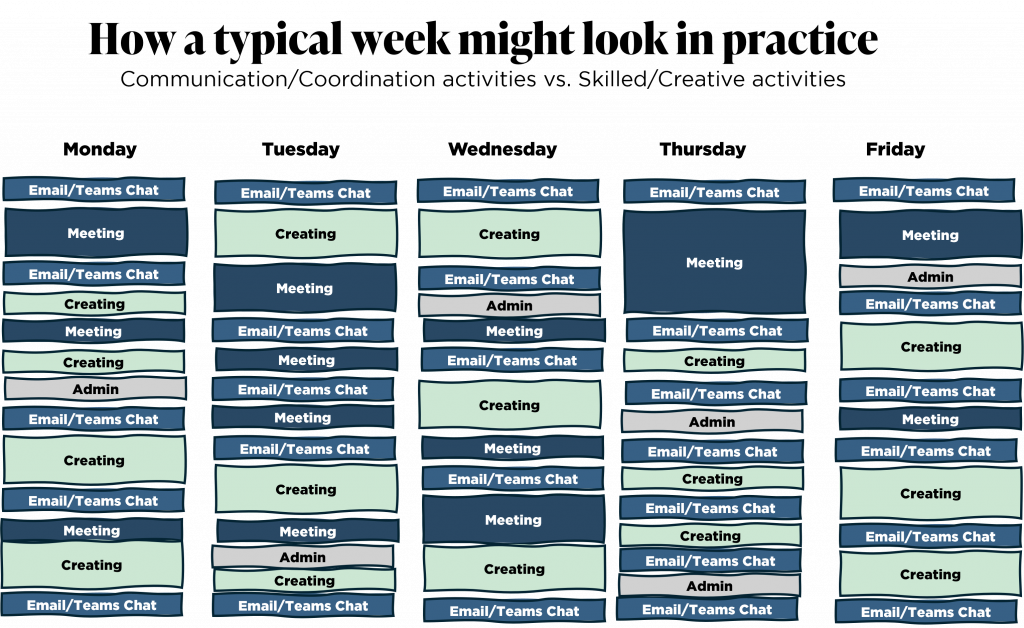
In the example above, I’ve assumed 3hrs a week (8%) are spent on administrative overhead (Budget/finance administration, filling out timesheets/status reports, HR tasks and updating project management tools).
This leaves 13 hrs for skilled/creative work, assuming people management tasks (1:1 meetings, coaching, performance reviews) are already assumed in coordination work. If you were actively working on 4 key projects in a quarter (say 3 customer-focused and 1 internal), how do you carve out sufficient time to drive each forward? Realistically, you are going to need to spend 3-4 hrs per project, and this will likely be spread across the week, given the need to keep all the plates spinning.
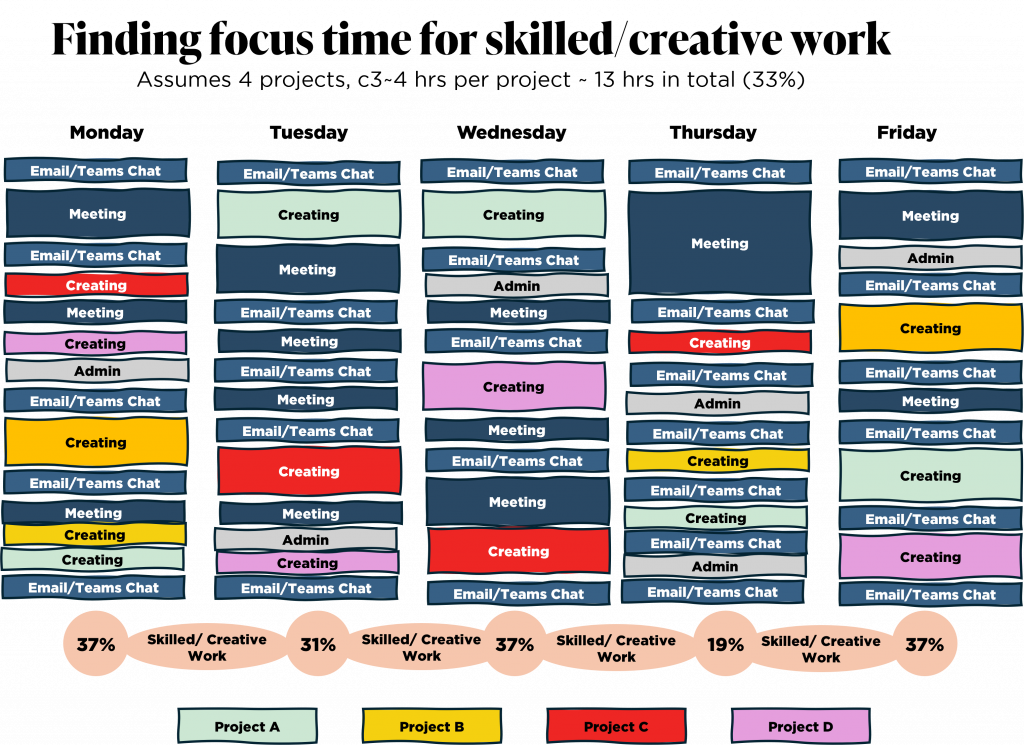
Building capacity – finding more time to work in a typical week
When we think this way about how we’re splitting our attention and focus, it’s no wonder that 80% of colleagues lack enough time or energy to do their work. So let’s think through some practical things you can do to free up more time. There are 7 areas.
1. Empowerment
Establish clear decision rights so people can act without constant consultation. Create decision criteria/guardrails so judgment improves. Document ‘when to escalate vs. when to decide’ guidance.
2. Training
Build the team’s capability so you are able to delegate more.
3. Strategic Avoidance
The 80/20 Ruthlessness. Identify which 20% of your meetings create 80% of the value or better still, which part of those meetings drive the value. Can you only attend in part? Make them async?
“Good Enough” Agreements. Decide upfront: what level of quality is sufficient for this? (not everything needs 100%).
Wait and see. Which problems will self-resolve without you? Which problems are valuable learning opportunities if you stay out?
Calendar Debt Reduction. Like technical debt, but for recurring commitments. Which standing meetings would you never schedule today? Cancel them.
4. Early Detection
Set expectations early. Communicate upfront what matters most in the deliverable.
Detect potential point of failure to reduce rework and firefighting later. Run a pre-mortem to surface hidden assumptions, resource conflicts and dependency risks upfront. Ask “Assume this fails spectacularly in 6 months. What happened?”
Catch issues when they’re whispers, not screams. In 1:1s, ask what’s wobbling? Where are the concerns?
Scope Management through earlier Milestone Reviews. Build-in checkpoints at 10%, and 25%. Catches drift early when correction is cheap.
5. Increase your leverage
Writing Over Speaking. One well-written doc (decision framework, strategy, how we think about guides) eliminates repeated conversations. What knowledge is trapped in your head that needs to be written down? What decisions are you making that could be delegated with a decision framework?
Cause over symptoms. When the same issue surfaces 3 times, stop solving instances. Zoom out and ask “What pattern is creating this?” For example, if you are frequently mediating resource conflicts, is this a decision architecture problem?
Coach more. When someone brings you a problem as what they have you considered and their recommendation. This gradually raises the bar for what gets escalated. Initially, it might feel that it slows you down but the eventual time savings will compound exponentially.
6. Information Flow
Exception-Based Reporting. Only escalate when variance from plan exceeds threshold.
Structured updates that force “what matters most that we discuss”. Instead of general updates, specify a format e.g. what changed since we last met?, what’s concerning you?, what decisions do you need from me?
7. Attention and Energy Management
Match Task Difficulty to Energy Level. Strategic thinking for when you’re fresh. Don’t waste peak cognitive hours on low-cognitive tasks.
Batch Similar Activities. Context switching is expensive and batching reduces switching costs. Protect your cognitive resources.
Buffer Time as Insurance. Protected buffer time on your calandar absorbs the urgent without destroying the important.
Response Time Agreements e.g. email: 24 hours, Teams Chat: 4 hours (non-urgent). Helps prevent constant monitoring.
In Summary
Capacity and Prioritisation go hand in hand but I recommend starting with being clear on how much capacity you have.
You are probably in the fortunate minority if you have as much as 13 hours a week available outside of communication tasks to do creative, strategic work that matches your skills.
To try and increase this by up to half a day (4 hours) will require deliberate effort in the 7 areas. The order of the areas matters. Empowerment is going to have a bigger impact than attention and energy management.
(1). You can read more about coordination bloat in Enabling Cultures: What Matters More Than AI for Team Potential, specifically points 5, 16 and 17.