The shadow cost of team size

Cross-functional teams are not new; they’ve been around for over 60 years. Early cross-functional representation experiments were designed to solve information awareness problems and a lack of knowledge sharing. Sequential handoffs (‘over the wall’) between functions create rework and delay. Concurrent, cross-functional working collapsed project time by bringing functional perspectives into development processes much earlier. Cross-functional adoption accelerated with the rise of Agile in the late 1990s and 2000s. Frameworks like Scrum are built on the foundation of small, self-organising, cross-functional teams that have all the skills necessary to take a project from idea to completion without external dependencies.
But we’re now collaborating too much
Nearly everything at work is now a collaboration. People typically work as part of several teams, concurrently juggling multiple projects. Technology and global working means there is no limit to how much you can collaborate. As a result, too much collaboration has been a growing pressure for over a decade, it’s two components being company overload (when a company has too many initiatives and demands in play) and personal overwhelm (employees within the company are overwhelmed by the overloaded system).
Too much of a good thing
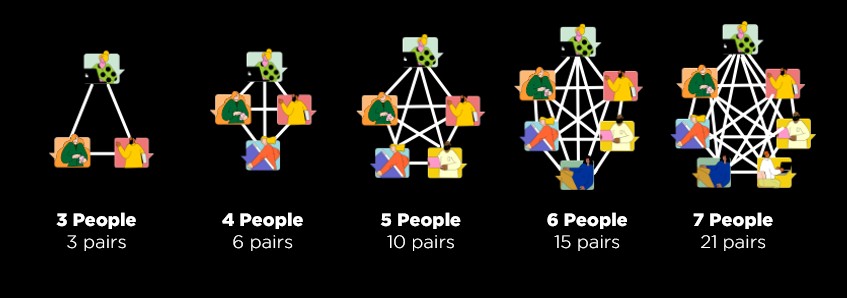
We know that including different functional views is helpful and often essential. We ask for people’s involvement in a project to increase its chance of success and out of respect. But each additional person adds a less-visible coordination cost. Two people have one conversation. Add a third person, and you now have three possible conversational pairs. Every new person you add must form a working relationship with every person already on the team:
The issue of representation without authority
Agile teams carry genuine end-to-end accountability. But as the model spread beyond software into general management, what transferred was the structure (functional representation), not the authority (the ability to make decisions on behalf of the function).
Which of these features of cross-functional team conversations do you recognise?
- Voices without votes. Team members in the discussion know their own opinions but cannot always represent the perspectives of stakeholders above them. They often have to take the cross-functional team recommendation back to their own functional leaders for approval.
- Too many opinions. The larger the team, the greater the number of different opinions. Groups aren’t equipped with facilitative techniques to integrate them. Meetings run for longer as a result.
- The Bystander effect. The more people in the room, the less any individual feels personally responsible for the outcome.
- Unsatisfactory compromise. With more voices, consensus pressure often means the team doesn’t find the best answer but instead the least objectionable one.
Cross-functional teams were the solution to silos. They have become the new problem, just a less visible one.
The cost of team size
The way we are working today means that too many people are involved in too many things, and the real cost of that involvement goes under the radar. We can all relate to the challenge of trying to find a time when everyone can meet. We can see the meeting time in our calendar. What’s less visible is everything else.
The visible component of team size
Beside meetings when the full team comes together, this includes the work individuals and different combinations of team members do between meetings to progress the work; preparing, drafting, modelling, synthesising etc.
The shadow cost
The nature of roles and responsibilities and cross-functional work means that people request input from specialists and stakeholders at various points throughout a project.
Alongside these advisor inputs, it’s likely that each team member is also regularly briefing and receiving steer from their line manager..
Lastly, there are the spontaneous questions and requests between various core team members that happens in chat and quick calls which are needed to stay aligned. The quick sync before the core team meeting, the message to unblock, the “can I just check something with you” that follows a contentious point. This is how good collaborative work actually happens. But the cost is invisible.
The bigger the team, the larger the collaboration debt
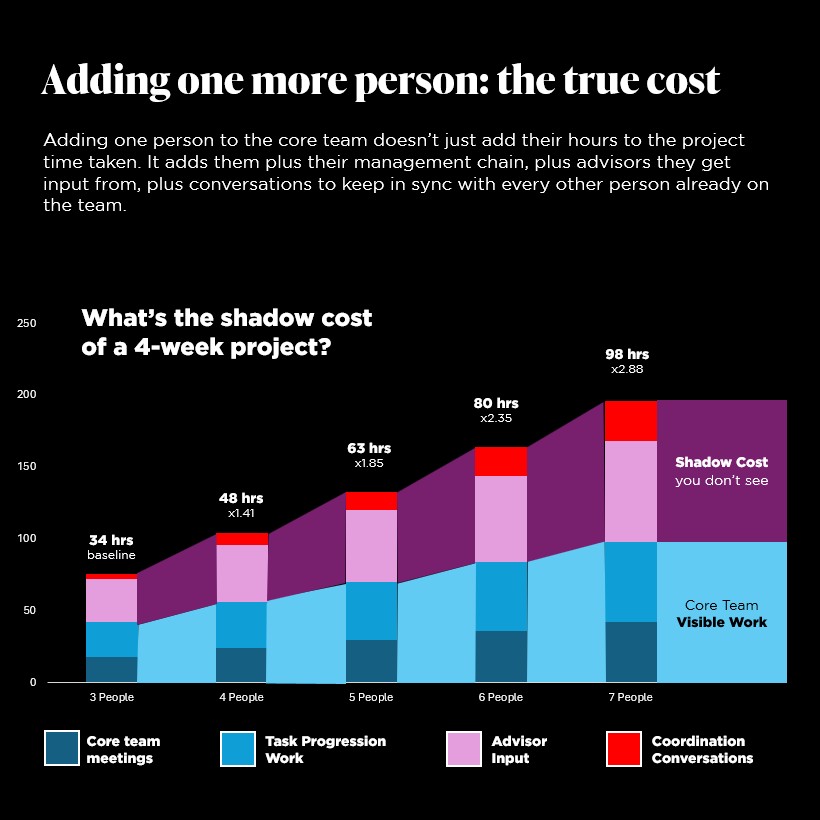
For every 1 core team hour spent doing the work, the team generates an additional 1 hr of shadow cost.
A core team of 7 members, each occasionally bringing in advisor input, generates 2.9 x the shadow cost of a core team of 3 who are only bringing in 3 advisors.
Footnote: Shadow cost model methodology and assumptions
The shadow cost model estimates the total person-hours consumed by a cross-functional team across a defined project period. It comprises five components.
1.Core team meetings: 1.5 hours per week multiplied by the number of core team members.
2.Task progression work: 2 hours per week per core team member, reflecting the individual and paired work that happens between meetings for every 90 minutes of formal meeting time.
3.Manager engagement: 1 hour per week per core team member, counting 30 minutes for the team member’s upward briefing and 30 minutes for their line manager’s participation in that conversation
4.Advisor coordination: 1.5 hours per week per advisor, counting 45 minutes for the advisor’s engagement and 45 minutes for the core team member facilitating the input
5.Pairing and sharing conversations: the informal coordination that arises between every active relationship pair in the team as a consequence of task progression work. Calculated as n(n−1)/2 multiplied by 20 minutes per week, where n is the number of core team members.
The graph in this article assumes a four-week project with 90 minutes of core team meeting per week and that the number of advisors equals the number of core team members.
All components scale linearly with project duration, so an eight-week project carries exactly twice the shadow cost of a four-week project across every configuration.
A 3-person team generates 34hrs of shadow cost over 4 weeks (Manager engagement 12hrs; Advisor coordination 18hrs; Pairing & Sharing Conversations 4hrs) in addition to 42hrs doing their own work (meetings and task progression).
A 7-person team generates 98hrs of shadow cost over 4 weeks (Manager engagement 28hrs; Advisor coordination 42hrs; Pairing & Sharing Conversations 28hrs) in addition to 98hrs doing their own work (meetings and task progression).